Bundle 5 & Save 15%.
Buy 10 & Save 20%.
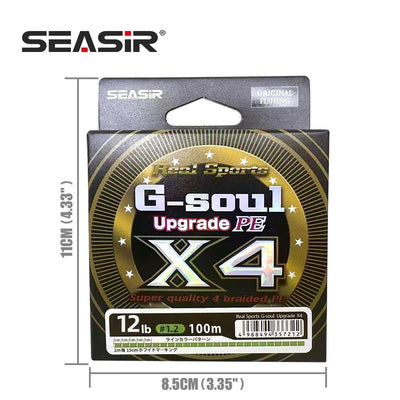
The SEASiR Real Sports G-soul Upgrade PE X4 is a 4-strand braided PE fishing line built to Japan-quality fishing line standards, available in 100m spools across 11 line weights from #0.2 (4LB / 0.083mm) to #4.0 (44LB / 0.320mm). High-visibility yellow finish. Advanced coating technology produces a near-perfectly round cross-section for cleaner guide passage and longer casts compared to standard 4-strand braid. Anti-curl construction straightens quickly after coiling. Available in two tiers: Micro-PE (#0.2–#0.6) for ultralight and finesse applications, and Universal-PE (#0.8–#4.0) for general inshore and offshore fishing.
Japan-Quality Standard
The G-soul X4 is positioned and packaged to Japanese fishing line quality standards — the packaging features Japanese-language line colour pattern notation and Japanese JIS barcode formatting, reflecting the Japanese PE braid engineering standards this line is built to. Japan has set the benchmark for braided PE fishing line quality since the mid-1990s: Japanese-standard PE braid is characterised by tighter strand-to-strand weave consistency, tighter diameter tolerance (diameter variation within ±0.005mm across the spool length), higher knot strength relative to rated breaking strain, and more consistent colour retention under UV and water exposure than commodity-grade braid. The “Upgrade PE” designation on the G-soul X4 packaging specifically refers to the coating technology upgrade that distinguishes this line from standard-grade PE braid.
Advanced Coating Technology — Near-Perfectly Round Cross-Section
The G-soul X4 is made with advanced coating technology that the product images confirm “produces a near perfectly round fishing line.” Standard 4-strand braid has a square or slightly flattened cross-section because four strands braided together leave gaps between the strand groups; the cross-section is round in some orientations and flat in others. The X4’s coating fills those inter-strand gaps, producing a circular cross-section regardless of orientation. A round braid passes through guide rings with less friction than a flat braid because the contact surface between the line and the guide ring is minimised — a flat section of line contacts the ring along a wider flat surface area, while a round section contacts only at the tangent point. Less guide friction means less energy loss on the cast, which the product’s own cast distance comparison image shows as a materially longer arc compared to other brand braided line of the same weight. The round profile also reduces line-on-line friction when the braid lays on itself on the spool, reducing bed formation and uneven spool build-up that causes tangles and wind knots.
Anti-Curl Construction
The X4 is confirmed anti-curl: “it can be straightened quickly even after repeated rubbing.” Braid memory and curl is caused by two things: inherent strand memory (the strands “remember” the coiled shape they were spooled in) and mechanical deformation from passing through guide rings and over the spool lip repeatedly. The X4’s tight weave structure resists inter-strand slippage — when strands slip relative to each other they create micro-kinks in the braid structure that accumulate into curl; a tight, locked weave prevents slippage and therefore prevents curl accumulation. The smooth coating also lubricates inter-strand contact during guide passage, reducing the mechanical deformation that contributes to curl from guide ring pressure.
Anti-Bite Wear-Resistant
The tight weaving process and smooth coating are confirmed to “greatly reduce the wear of the thread.” Two wear mechanisms affect braid during use: abrasion from structure contact (rock, reef, pilings, weed stems) that cuts individual strands; and bite wear where fish teeth, gill plates or sharp body armour cut the line during the fight. The X4’s tight weave presents fewer exposed strand surfaces to abrasive contact than a loose weave — the strands support each other under lateral compression from an abrasive surface; the smooth coating adds a sacrificial friction layer over the strand surface that wears before the UHMWPE fibre beneath it.
Micro-PE and Universal-PE — Two Distinct Tiers
The X4 spec chart splits the 11 line weights into two categories:
Micro-PE (#0.2, #0.4, #0.6) — ultra-fine diameter range for finesse and specialist applications. Diameters from 0.083mm to 0.128mm achieve breaking strains of 4–8LB. These diameters are substantially thinner than standard fishing line — a 4LB monofilament typically runs 0.16–0.18mm; the #0.2 X4 at 0.083mm is approximately half that diameter at the same breaking strain. Micro-PE is used for finesse lure presentations to wary species in clear water where line visibility is a significant factor in triggering or refusing the strike; for panfish, light bream, stream trout and similar light-tackle species where the maximum drag and fighting capacity of the tackle is well below 10LB; and in ajing, mebaru, and other Japanese-derived finesse techniques that require the lightest possible line to animate small jigs and lures correctly.
Universal-PE (#0.8 through #4.0) — the standard inshore and offshore range covering 10LB to 44LB across 8 line weights from 0.140mm to 0.320mm. This tier covers the majority of Australian estuary, inshore and light offshore applications: flathead, bream and whiting on #0.8–#1.2; bass, barramundi and medium snapper on #1.5–#2.0; heavier snapper, kingfish surface lures and offshore jigging on #2.5–#4.0.
Full Specification Chart
Micro-PE
-
#0.2 — 0.083mm — 4LB
-
#0.4 — 0.105mm — 6LB
-
#0.6 — 0.128mm — 8LB
Universal-PE
-
#0.8 — 0.140mm — 10LB
-
#1.0 — 0.160mm — 11LB
-
#1.2 — 0.181mm — 12LB
-
#1.5 — 0.205mm — 16LB
-
#2.0 — 0.234mm — 24LB
-
#2.5 — 0.260mm — 28LB
-
#3.0 — 0.280mm — 35LB
-
#4.0 — 0.320mm — 44LB
Line Weight Selection Guide
-
#0.2–#0.4 (4–6LB): ultralight finesse fishing; ajing, mebaru, light bream and panfish; pairs with 500–1000 size spinning reels; 0.083–0.105mm allows extremely small lures (0.5–3g) to cast and animate correctly
-
#0.6–#0.8 (8–10LB): light lure fishing for bream, whiting and small flathead in estuaries; suits 1000–2000 spinning reels; balances finesse presentation with enough strength for active fish
-
#1.0–#1.2 (11–12LB): the most popular inshore estuary weight; suits flathead, bream and trevally on soft plastics and hard bodies; pairs with 2000–2500 reels
-
#1.5–#2.0 (16–24LB): medium estuary and impoundment; barramundi, bass, snapper; handles aggressive runs without breaking; pairs with 2500–3000 reels
-
#2.5–#3.0 (28–35LB): heavier inshore and light offshore; surface lures for kingfish and GT, heavier snapper; pairs with 3000–4000 reels
-
#4.0 (44LB): offshore jigging, heavy rock fishing, larger pelagics; pairs with 4000–5000 reels
Specifications
- Brand: SEASiR
- Model: Real Sports G-soul Upgrade PE X4
- Strands: 4
- Length: 100m per spool
- Colour: High-visibility yellow
- Line weights: 11 (#0.2 to #4.0)
- Breaking strain range: 4LB to 44LB
- Diameter range: 0.083mm to 0.320mm
- Buoyancy: Floating
⚠️ Safety Notice: This product contains sharp hooks and small parts. Handle with care. Not suitable for children under 3 years. Colours may vary slightly from images shown due to screen settings and product availability. Always follow safe fishing practices.