Impossible de charger la disponibilité du service de retrait
Achetez-en 3 et économisez 10 %
Achetez-en 5 et économisez 15 %.
Achetez-en 10 et économisez 20 %.
Quantité
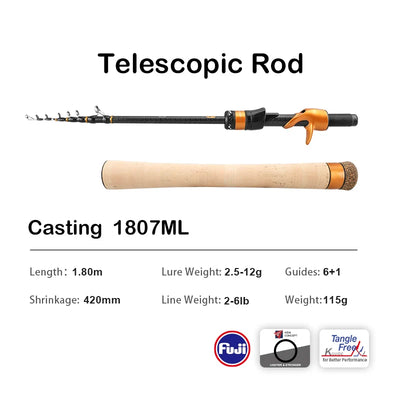
The PURELURE BFS Telescopic Stream Rod is an extra-ultralight (XUL) telescopic carbon rod built for finesse stream fishing with Fuji guides, a solid carbon tip section and a detachable rear handle for maximum packability. Available in spinning and baitcasting (casting) configurations across lengths from 1.50m to 2.10m. Suited to stream and impoundment trout, bass and bream fishing where presentation accuracy, sensitivity and compact transport are the primary requirements.
BFS — Bait Finesse System
BFS (Bait Finesse System) is a Japanese fishing system developed around the goal of casting very light lures (0.5–5g) on baitcasting reels without the backlash problems that conventional baitcasting reels produce at these lure weights. A BFS reel uses an extremely lightweight, low-inertia spool — typically machined aluminium or titanium with a shallow-cut profile — that decelerates as quickly as it accelerates, allowing the spool to stop when line tension drops without overrunning and producing a backlash. A BFS rod is designed to complement this system:
XUL power rating: extra-ultralight power means the rod blank loads (bends) under very light lure weights of 0.5–3g; at these weights, a standard-power blank would remain stiff and not contribute to the cast; an XUL blank bends progressively with these light lures, storing energy in the blank during the cast stroke and releasing it as the lure accelerates forward; the blank becomes part of the casting mechanism rather than being a passive conduit
Slow action: the rod’s bend point is deep into the blank (toward the butt) rather than near the tip; a slow action rod loads throughout its full length on the cast, maximising the stored energy available from such a light lure weight; the slow action also produces a wider casting arc that gives the angler more time and control over the cast path for accuracy in confined stream environments
Solid tip for BFS sensitivity: the tip section is a solid carbon rod rather than a hollow tube; a solid tip transmits surface vibration (lure contact with rocks, substrate, current changes) into the blank more directly than a hollow tip, providing the tactile feedback required to fish a 1g lure in moving water and detect takes from small fish at micro-lure sizes
Solid Carbon Tip Section
The top section of the PURELURE BFS is a solid carbon tip with a 1mm top diameter. Solid tips are common in high-end trout, finesse and ajing rods for two reasons:
Progressive sensitivity: the solid section flexes in response to very small loads — the weight of a small lure, the drag of current on the line, the tap of a small fish — without the minimum load threshold that a hollow tube tip requires before it deflects; at 1mm diameter, the solid tip responds to forces that would not move a hollow tip of equivalent length
Impact resistance: solid carbon tips do not shatter on impact the way hollow tube tips can when a collapsing section strikes another during retraction or when the rod contacts a rock or branch; for a telescopic rod used in dense stream vegetation, this is a practical advantage
High-Carbon Low-Resin Blank
The PURELURE BFS blank uses a hybrid fibre construction with reduced resin content relative to standard carbon blanks. In carbon rod blank manufacturing, the resin matrix binds the carbon fibre layers together; higher resin content adds weight without adding stiffness or tensile strength, while reducing the proportion of load-bearing carbon fibre per unit of blank volume. By reducing resin content and increasing carbon fibre density, the blank achieves:
Lower weight per unit length: less resin mass means a lighter blank; at 1.50–1.75m, a lighter blank allows the rod to be balanced closer to the reel seat, reducing tip-heaviness during extended casting sessions
Higher sensitivity: a denser carbon fibre matrix transmits vibration through the blank faster and with less damping than a resin-rich matrix; the rod tip’s response to lure movement reaches the handle more directly
Maintained toughness: the hybrid fibre component (typically glass or aramid fibre blended with the carbon) compensates for the brittleness that very high-carbon blanks can exhibit; a pure ultra-high-carbon blank is stiff and sensitive but can snap on impact; the hybrid approach targets the balance point between sensitivity and impact toughness
Unique Section Transition Angle
The telescopic sections use a specifically developed cutting angle at each section joint rather than a standard straight-cut joint. In a standard telescopic rod, each section steps down in diameter with a straight-cut shoulder; under casting load, this shoulder creates a stress concentration at the joint and a slight irregularity in how the load transfers from one section to the next. The PURELURE BFS’s angled section transition distributes the load transfer across a longer contact surface at each joint, reducing the stress concentration and producing a more continuous, progressive bend through the full length of the blank when casting. The effect on casting feel is a rod that behaves more like a one-piece blank in its bending profile than a typical telescopic rod.
Fuji Guides
All variants use Fuji guide frames — the Japanese premium guide manufacturer whose SIC (Silicon Carbide) ring inserts and titanium or stainless alloy frames are the benchmark for guide performance on high-end rods. Fuji guides are specified on this rod for two reasons relevant to ultralight fishing: Fuji SIC rings have an extremely smooth and hard surface that reduces friction on the line during the cast (critical for casting 1–3g lures where line friction is a significant portion of the total resistance); and Fuji frames maintain guide ring alignment precisely over the life of the rod, which prevents the slight ring misalignment that causes line wear and uneven stress loading on light line.
Detachable Rear Handle
The rear handle section is designed to detach from the rod body, further reducing the collapsed length beyond what a standard telescopic rod achieves. In practice, the collapsed rod without the rear handle section fits into a jacket pocket or compact rod case for stream access through dense bush, kayak storage or backpack transport. The reel seat uses solid wood construction — a warm-feel, traditional aesthetic common in premium Japanese stream rods — which is lighter than EVA foam handles of equivalent size while providing a firm, vibration-transmitting grip surface at the reel seat position.
Variant Selection Guide
FUJI Spinning 1.50m: spinning configuration, shortest length; maximum compactness for tight stream environments and access through dense vegetation; suits 1000–2000 spinning reels with PE #0.2–#0.4 or 2–4lb leader
FUJI Spinning 1.75m: spinning configuration, mid length; the most versatile spinning length in the range; suitable for small to medium streams and open impoundment edges; suits 1000–2500 spinning reels
FUJI Spinn210 ML (Red/Gold): spinning configuration at approximately 2.10m; the longest spinning variant; suits more open water — wider streams, impoundment banks and light coastal applications; ML (medium-light) power at this length; available in Red and Gold finish
FUJI Casting 1.50m: baitcasting (BFS reel) configuration at 1.50m; the primary BFS-specific configuration; suits BFS baitcasting reels with very light spool and PE #0.3–#0.6 braid; for casting 0.5–3g lures in stream environments
FUJI Casting 1.75m: baitcasting configuration at 1.75m; longer BFS casting variant for open stream and impoundment use; suits BFS reels with 0.5–3g lures
FUJI Cast180 ML (Red/Gold): baitcasting configuration at approximately 1.80m; ML power at this length; available in Red and Gold finish
⚠️ Avis de sécurité : Ce produit contient des hameçons pointus et de petites pièces. Manipuler avec soin. Ne convient pas aux enfants de moins de 3 ans. Les couleurs peuvent varier légèrement des images présentées en raison des paramètres de l'écran et de la disponibilité du produit. Toujours respecter les pratiques de pêche sécuritaires.