Inkl. Steuern.
Versand wird beim Checkout berechnet
Verfügbarkeit für Abholungen konnte nicht geladen werden
Bundle 3 & save 10%
Bundle 5 & Save 15%.
Buy 10 & Save 20%.
Anzahl
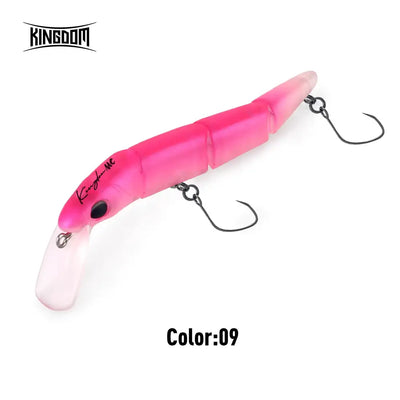
The Kingdom 4-Section Jointed Minnow is a slow-sinking 75mm hard body lure with three joints connecting four body sections and a single high-carbon steel hook. Available in 6 colour variants. Suited to Australian bass, bream, estuary perch and light estuary species on slow to medium retrieves in freshwater and estuary environments. $19.95.
What Four Sections Mean
Most jointed minnows are built in two sections with a single joint. A two-section lure articulates at one point, producing a pronounced tail kick on each side of the centre joint on the retrieve. The Kingdom lure has four body sections connected by three joints. Three joints produce a qualitatively different swimming action:
More articulation points — each joint adds one more flexion point across the lure’s body length; three joints across a 75mm lure means joints at roughly 19mm, 38mm and 57mm from the nose; on the retrieve each section moves semi-independently, producing a continuous S-curve through the body rather than a single tail-kick pivot
Snake-like swimming action — the continuous S-curve through three joints at slow to medium retrieve speeds mimics the lateral undulation of a small eel, gudgeon or goby — species that Australian bass, bream and estuary perch actively hunt in riparian and estuary environments; no two-section lure of the same size produces this undulation pattern
Wider action at slow speeds — the three-joint construction allows each section to swing wider at slow retrieve speeds without the lure spinning or losing track; the source notes explicitly that slow reeling produces a large swing — this is the multi-joint construction enabling an action that would cause a rigid or two-section lure to hunt and roll rather than swing cleanly
Slow-Sinking Action — Depth Control
The lure sinks slowly when the retrieve stops — it does not float (unlike a floating minnow) and does not sink fast (unlike a standard sinking lure). The slow-sink designation gives the angler control over the depth fished on each cast:
Count-down depth control — after casting, allow the lure to sink for a counted number of seconds before beginning the retrieve; each second of sink places the lure deeper; repeating the same count on subsequent casts keeps the lure at the same depth; this is the most practical depth control method for targeting fish holding at a specific depth without structure markers
Pause-and-sink retrieve — during the retrieve, a rod-tip pause allows the lure to slowly sink a short distance before the retrieve resumes; for bass and bream holding on or near the bottom, the slow sink on each pause brings the lure back into the strike zone between retrieve strokes; a floating minnow rises on the pause and moves away from bottom-holding fish
All water levels — the count-down control means the same lure can be fished from just below the surface (short count) through mid-water to near the bottom (long count) without changing lures; one lure covers the full water column depending on the count and retrieve speed used
Fast vs Slow Retrieve
The three-joint construction responds differently across the retrieve speed range:
Fast retrieve — rapid search: at higher speeds the three joints produce a tight, high-frequency wobble and the lure tracks a straight path; effective for covering water quickly to locate active fish; bass and trevally will strike on a fast-retrieve pass when actively feeding
Slow retrieve — wide swing: at slow speeds each joint allows a wider swing, producing the pronounced S-curve undulation; this is the primary action mode for this lure and is most effective for finicky or lethargic fish; bream and estuary perch in pressured or cold-water conditions will follow a fast lure and turn away, then commit to a slow-swinging multi-joint minnow on the next cast
Single Hook
The lure is fitted with a single high-carbon steel hook rather than treble hooks. Single hooks have two advantages for this lure style and size:
Less drag, more action — a treble hook on a 75mm 4.3g lure adds measurable weight and drag to the tail section; on a slow-sinking, multi-joint lure where the tail swing is the primary action driver, a lighter single hook allows more freedom of movement in the tail section; the three joints amplify small differences in tail drag into visible action differences
Weed resistance — a single hook is less prone to fouling on weed and debris during the retrieve than a three-point treble; important for fishing bass and bream habitat that typically involves submerged weed, trailing grass and light debris
The hook uses a special angle and quenching process — heat treatment that hardens the high-carbon steel after forming — to ensure the point and shank do not deform under fighting load. The quenching process is what distinguishes a performance fishing hook from a standard wire hook of equivalent gauge.
Advanced Plating and Coating
The lure body uses an advanced plating technology that the manufacturer specifies will not peel under long-term use. Paint peeling on soft or cheaply finished hard body lures exposes the base material, creates an uneven surface that affects swimming action, and produces a worn visual appearance that reduces the lure’s effectiveness. The Kingdom plating process is intended to maintain both the lure’s visual finish and its swimming characteristics across an extended service life.
Target Species
Australian Bass — the primary freshwater target; bass respond strongly to the slow, wide-swinging multi-joint action on a pause-and-sink retrieve around submerged timber and weed edges in impoundments and coastal rivers; the 75mm size is effective for bass in the 0.3–1kg class
Bream — the slow retrieve in estuary environments around rock walls, jetty pylons and weed edges; bream follow and inspect lures closely before committing; the wide-swinging action at slow speed with a slow-sink pause is particularly effective for hesitant bream in clear estuary water
Estuary Perch — slow retrieve along river banks, rock ledges and fallen timber in coastal rivers; estuary perch are ambush predators that respond to the undulating action of a multi-joint lure mimicking an eel or gudgeon moving along a bank
Flathead — the count-down slow-sink retrieve to keep the lure near the bottom over sand and mud flats; the slow-sinking pause brings the lure back into the bottom strike zone between retrieve strokes
Specifications
Brand: Kingdom
Model: 5517
Length: 75mm
Weight: 4.3g
Action: Slow sinking
Body sections: 4 (three joints)
Hook: Single, high-carbon steel, quenched
Colour variants: 6
Price: $19.95
⚠️ Safety Notice: This product contains sharp hooks and small parts. Handle with care. Not suitable for children under 3 years. Colours may vary slightly from images shown due to screen settings and product availability. Always follow safe fishing practices.